
The best way to know what OPSC will ask in the ASO 2026 written exam is to study what it actually asked before. We digitised and classified every question from the OPSC ASO papers of 2015, the 2015-16 Special Recruitment, 2018-19 (exam held 20 January 2019) and 2021-22 (exam held 27 August 2022). This article turns that work into clear numbers and charts, subject by subject, followed by a study plan.
The 2026 advertisement (No. 15 of 2026-27) keeps the same three written papers: General Awareness (100), Reasoning 50 + Mathematics 50, and English 100 + Odia 100, with −0.25 for each wrong answer. So the past papers remain an excellent guide. Read the OPSC ASO 2026 notification guide for vacancies and dates.
The Big Picture
| Paper | What decides your score | Difficulty in past papers |
|---|---|---|
| I: General Awareness | Strong static GK (geography, polity, environment, history) plus current affairs mixed into every topic | Mostly easy to moderate; 7% hard |
| II: Reasoning + Maths | Speed and accuracy on standard topics; algebra and probability in maths | Maths mostly easy; reasoning has the most hard questions |
| III: English + Odia | Grammar rules applied in sentences; Odia spelling, synonyms and verb grammar | English easiest; Odia the toughest of all |
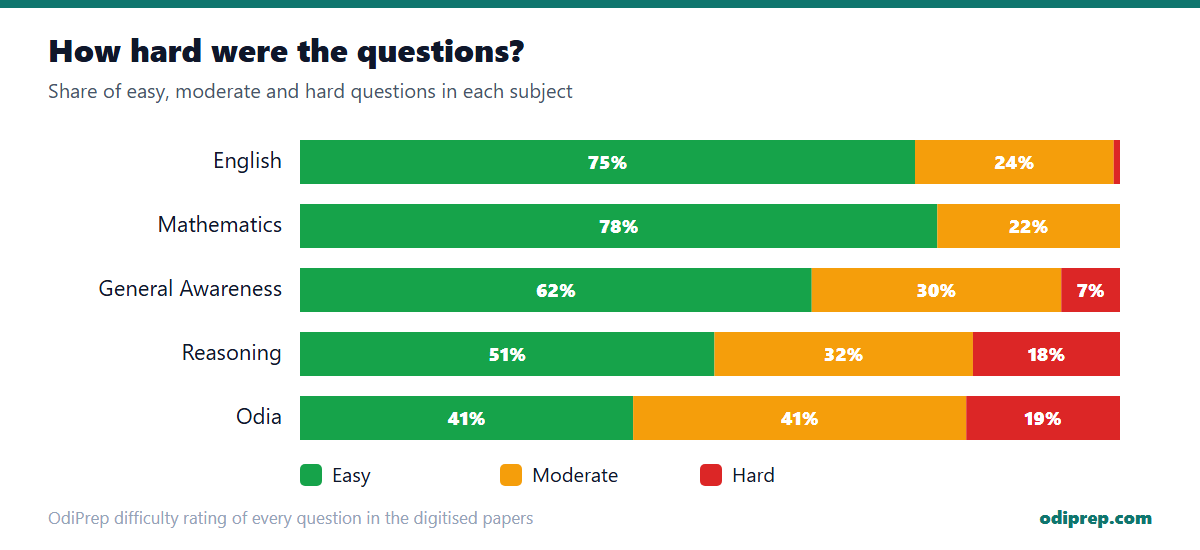
What this means: English and Mathematics are the most scoring areas (about three quarters of questions were easy), while Odia and Reasoning decide rankings because nearly one in five questions was hard. Since you must reach the minimum in every paper separately, Odia deserves daily practice.
Paper I: General Awareness
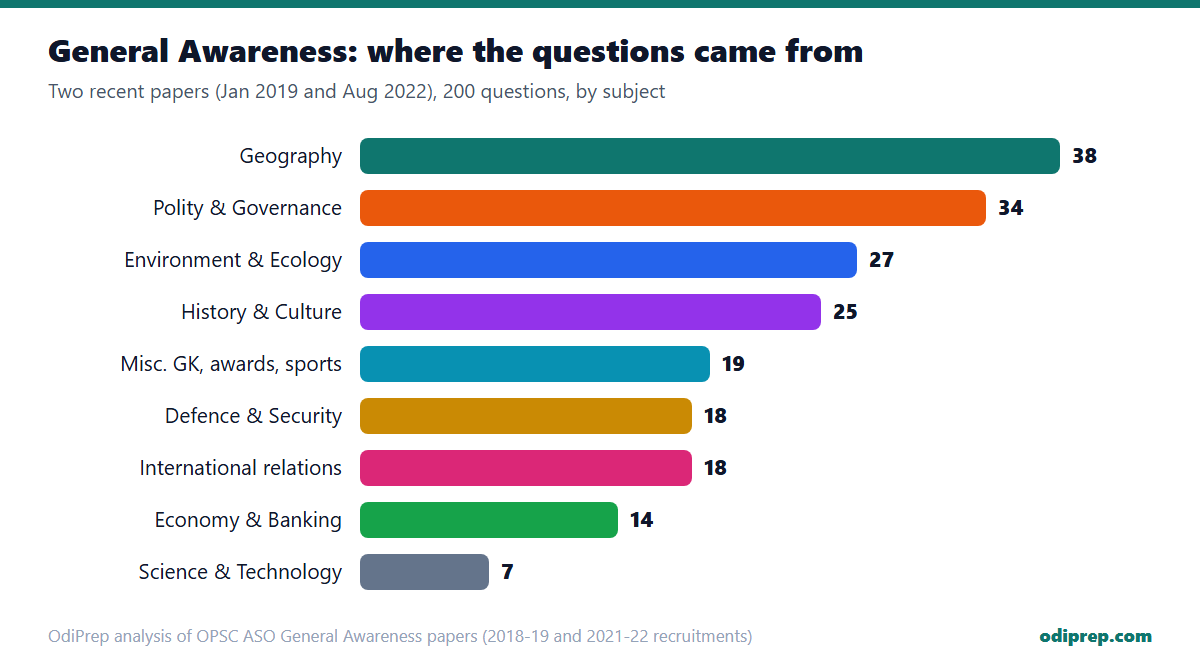
Across the two most recent papers (200 questions):
| Subject | Questions | Share |
|---|---|---|
| Geography | 38 | 19.0% |
| Polity, Governance & Law | 34 | 17.0% |
| Environment & Ecology | 27 | 13.5% |
| History & Culture | 25 | 12.5% |
| Miscellaneous GK, awards, sports | 19 | 9.5% |
| Defence & Security | 18 | 9.0% |
| International Relations & Organisations | 18 | 9.0% |
| Economy & Banking | 14 | 7.0% |
| Science & Technology | 7 | 3.5% |
Key findings
- Four foundation subjects make up about 62% of General Awareness: geography, polity, environment and history. Build these first.
- Odisha matters. The 2022 paper asked about Odisha's rolling uplands, rivers forming the coastal plain, soil groups and monsoon mechanisms: specific, concept-based questions, not just "longest river" facts.
- Environment rose sharply (10 questions in 2019 to 17 in 2022), matching the 2026 syllabus line on ecology, biodiversity and climate change.
- Current affairs are hidden inside other subjects: defence exercises, international organisations, government schemes, awards and appointments. A dedicated current affairs routine is essential.
- Defence & Indian Armed Forces is a named syllabus item and had 18 questions in two papers. Treat it as its own module.
Study order for Paper I: Indian and Odisha physical geography → Constitution and governance → environment and ecology → modern history and the freedom struggle → defence → international organisations → economy basics → science in daily life, with current affairs every day.
Paper II (B): Mathematics
| Topic | Questions (4 papers) |
|---|---|
| Algebra | 51 |
| Statistics & Probability | 50 |
| Number System | 31 |
| Mensuration | 26 |
| Arithmetic | 25 |
| Sets & Functions | 6 |
| Geometry | 3 |
| Trigonometry | 1 |
Key findings
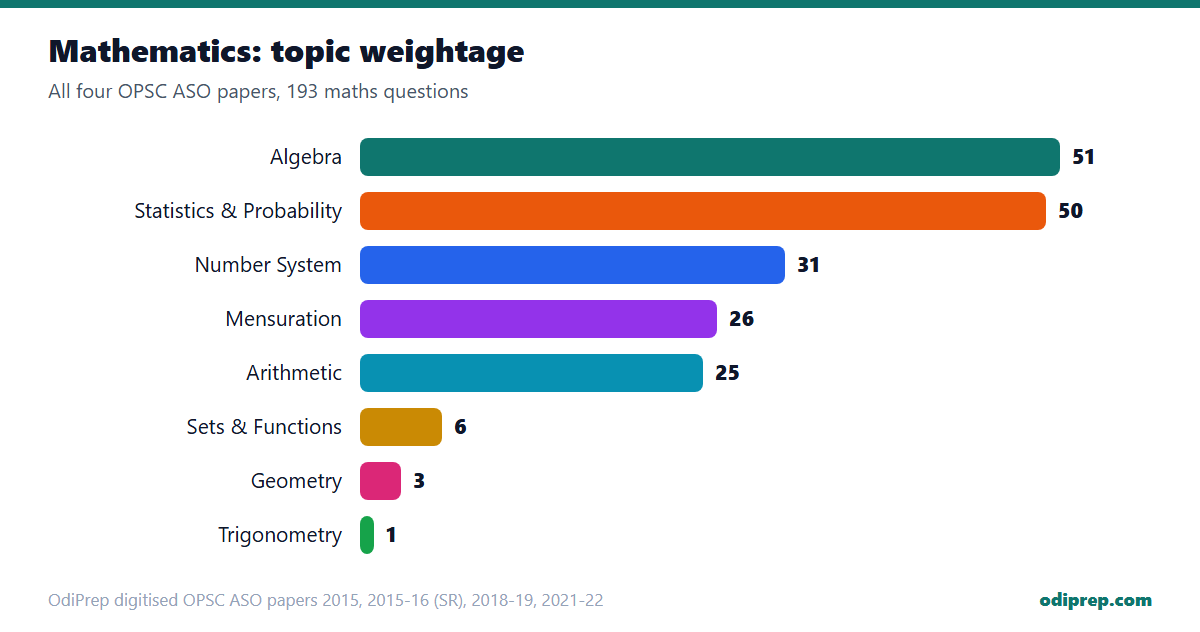
- Algebra and statistics/probability together are over half of all maths questions. Many candidates prepare only "arithmetic"; the ASO paper rewards 10th-standard algebra (linear and quadratic equations, discriminant, identities, remainder theorem) and probability (coins, dice, cards, "53 Sundays" type).
- Statistics questions use mean, weighted average, median, mode and mean deviation.
- Mensuration includes 3D shapes (cone, cylinder, sphere).
- 78% of maths questions were easy. With practice, maths is the best place to secure Paper II's minimum quickly.
Paper II (A): Reasoning & Mental Ability
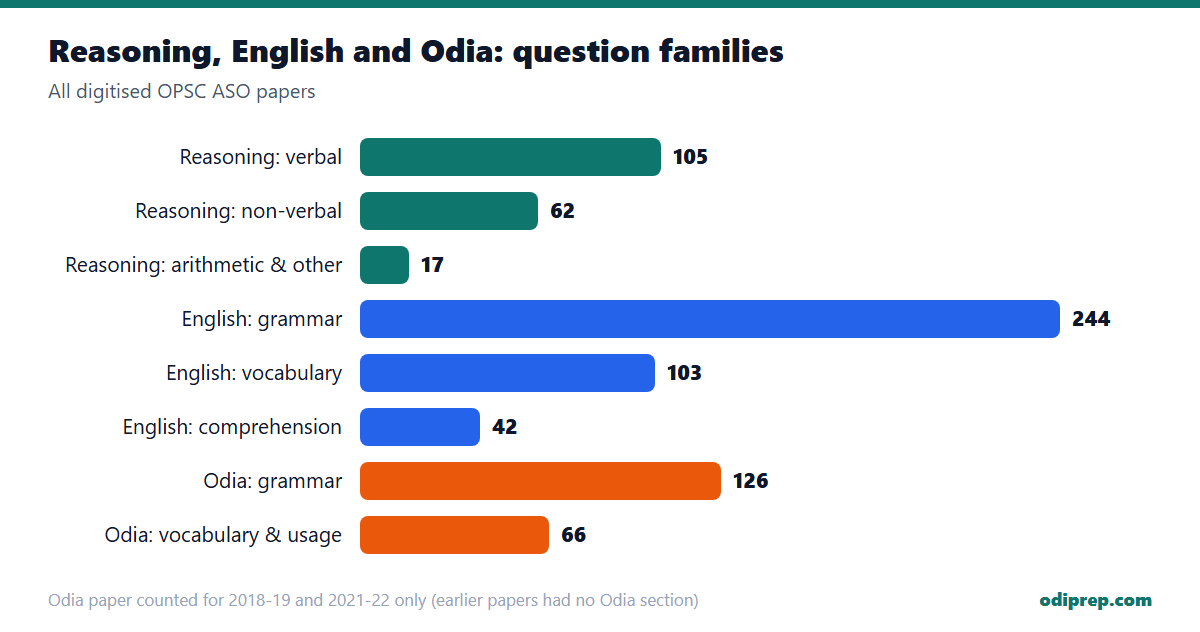
- Verbal reasoning (105 questions) clearly leads non-verbal (62). Coding-decoding, series (number and letter), ranking and order, direction sense, blood relations and age problems repeat in every paper.
- Non-verbal is visual and time-consuming: counting triangles, cube nets, painted cubes, dice, mirror images, embedded figures. The 2022 paper had a three-question painted-cube set.
- Reasoning had the highest share of hard questions (18%). Solve easy verbal items first and come back to long figure puzzles.
Paper III (A): English
| Question family | Questions (4 papers) |
|---|---|
| Grammar | 244 |
| Vocabulary | 103 |
| Comprehension & composition | 42 |
- Grammar is nearly two-thirds of English. Tenses, subject-verb agreement, prepositions, articles, voice and narration, and error spotting appear every year.
- Vocabulary is asked in context (antonyms, synonyms, word meanings in sentences), not as isolated word lists.
- A reading passage with 4–5 questions and sentence rearrangement (named in the 2026 syllabus) complete the paper.
- 75% of English questions were easy, making it the highest-scoring section for most candidates.
Paper III (B): Odia
- Odia appeared in the 2018-19 and 2021-22 papers: 126 grammar and 66 vocabulary/usage questions in total.
- The 2022 paper opened with ଶୁଦ୍ଧ ଶବ୍ଦ (correct spelling) questions 101–110, then ପ୍ରତିଶବ୍ଦ (synonyms) 111–120 and ବିପରୀତ ଶବ୍ଦ (antonyms), followed by a long block on କ୍ରିୟା (verbs), କାଳ (tense), କର୍ତ୍ତା-କ୍ରିୟା ସମ୍ବନ୍ଧ and sentence correction.
- Only 41% of Odia questions were easy and 19% were hard, the toughest mix in the exam. Spelling (ଣ/ନ, ଶ/ଷ/ସ, ଡ଼/ଡ, vowel length, conjuncts) is where most marks are lost.
Daily habit: 20 spelling items + 10 synonym/antonym items + 10 verb/tense items. It adds up to the strongest improvement in Paper III.
Paper IV: Computer Skill Test (qualifying)
The 2022 skill test had five 10-mark tasks: a formatted Word document, two Access databases (tables, queries, forms, reports and a relationship), an Excel salary sheet with formulas, sorting and a bar chart, and a PowerPoint presentation with a chart and slide-master footer. You need 40% to qualify, so practise each application at least once on a real computer.
Turning the Analysis into a Plan
- Take one full mock first to see where you stand in each paper against the minimum (35/35/70 for UR and SEBC).
- Fix the paper closest to the minimum first. For most candidates this is Odia or Reasoning.
- Build Paper I foundations in the 62% block (geography, polity, environment, history) before chasing rare facts.
- Practise maths topic-wise, especially algebra and probability.
- Take full-length mocks weekly in the real order and timing, then review every wrong answer.
Practise the real papers yourself, with timing and answer explanations:
Target exactly the topics where you lose marks:
Method note: counts come from OdiPrep's question-by-question classification of the digitised OPSC ASO papers. Cancelled questions are not counted. General Awareness subject shares use the two recent papers (2018-19 and 2021-22); maths, reasoning, English and difficulty use all four papers; Odia uses the two papers that had an Odia section. Classification of some questions can be debated, so treat small differences as indicative.