
The OPSC Assistant Executive Engineer (AEE), Civil is the top technical entry post for civil engineers in Odisha's Water Resources, Works, Housing & Urban Development and Panchayati Raj departments. This analysis explains the exam pattern, the official syllabus weights and what the real papers have asked, so you know exactly where the marks are.
We classified 943 questions from 8 OPSC AEE papers (2016 to 2023) by subject, chapter, format and difficulty, as part of a wider study of 1,567 verified questions from 15 Odisha civil engineering papers.
The Big Change for 2026-27: GATE Score Plus Interview
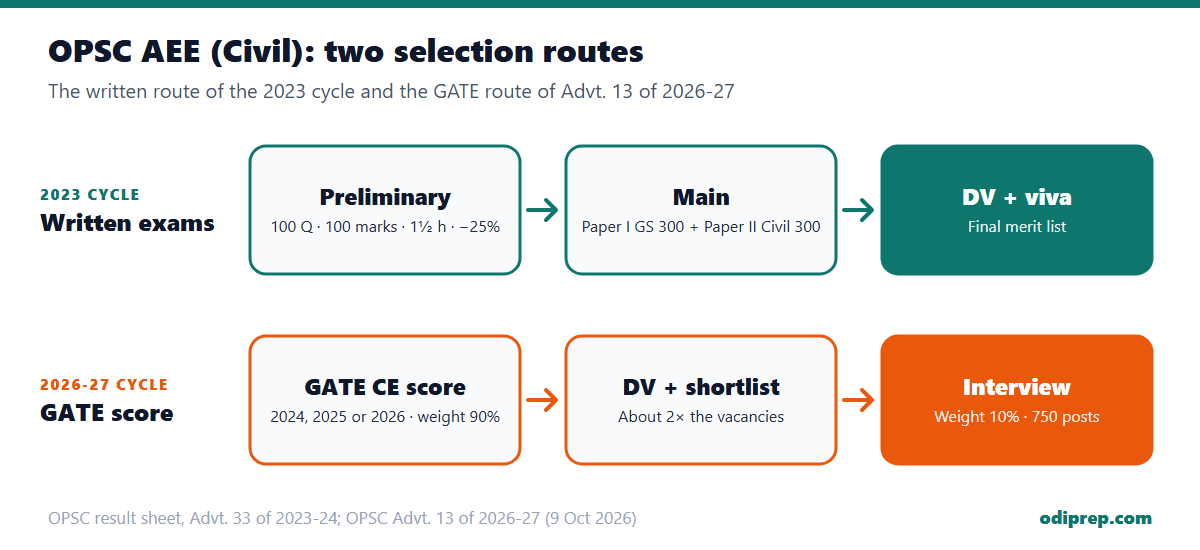
OPSC Advertisement No. 13 of 2026-27 (9 October 2026) is for 750 AEE (Civil) posts (247 for women) and 8 AEE (Mechanical) posts. This time there is no OPSC written exam:
| Item | Advt. 13 of 2026-27 |
|---|---|
| Posts | 750 AEE (Civil): UR 374, SC 83, ST 232 (612 backlog + 138 current) |
| Selection | GATE CE score 90% + interview 10% |
| GATE score accepted | GATE 2024, 2025 or 2026, at or above the category qualifying mark |
| Qualification | BE/B.Tech (Civil) or AMIE (Civil) plus a valid GATE CE score |
| Age | 21–42 years as on 01.01.2026 (usual relaxations) |
| Pay | Level-12, Cell-1 (ORSP Rules 2017) |
| Applications | Closed on 11.11.2026; document verification tentatively from the first week of December 2026 |
About two candidates per vacancy in each category are called for the interview after document verification. Ties go first to higher interview marks, then to the older candidate. Always confirm details on opsc.gov.in.
Why OPSC papers still matter: the written scheme below was used for the 2023 recruitment and remains OPSC's notified syllabus for written AEE cycles. The same core subjects are tested in GATE CE, so the PYQs are excellent concept practice for both routes.
The Written Exam Pattern (2023 Cycle)
| Stage | Paper | Questions | Marks | Negative marking | Time |
|---|---|---|---|---|---|
| Preliminary (screening) | Civil Engineering | 100 | 100 | 0.25 per wrong answer | 1½ hours |
| Main Paper I | General Studies (General Science 100 Q + General Awareness 50 Q) | 150 | 300 | 0.5 per wrong answer | 2 hours |
| Main Paper II | Civil Engineering | 150 | 300 | 0.5 per wrong answer | 2 hours (the 2023 booklet printed 2½ hours) |
| Final | Document verification and viva voce |
- Qualifying marks in 2023: 30% in the Prelim to reach the Main, and 30% in the Main to be called for the viva, for all categories.
- 2023 dates: Prelim on 8 December 2024; Main on 11 May 2025.
Marks of finally selected candidates (Advt. 33 of 2023-24, OPSC result sheet)
| Category | Male (highest / lowest) | Female (highest / lowest) |
|---|---|---|
| UR | 412.405 / 319.581 | 345.878 / 272.351 |
| SEBC | 315.108 / 305.838 | 271.230 / 265.676 |
| SC | 307.108 / 251.838 | 251.257 / 223.324 |
| ST | 247.486 / 211.446 | 228.865 / 228.865 |
The Preliminary: Ten Blocks of Ten
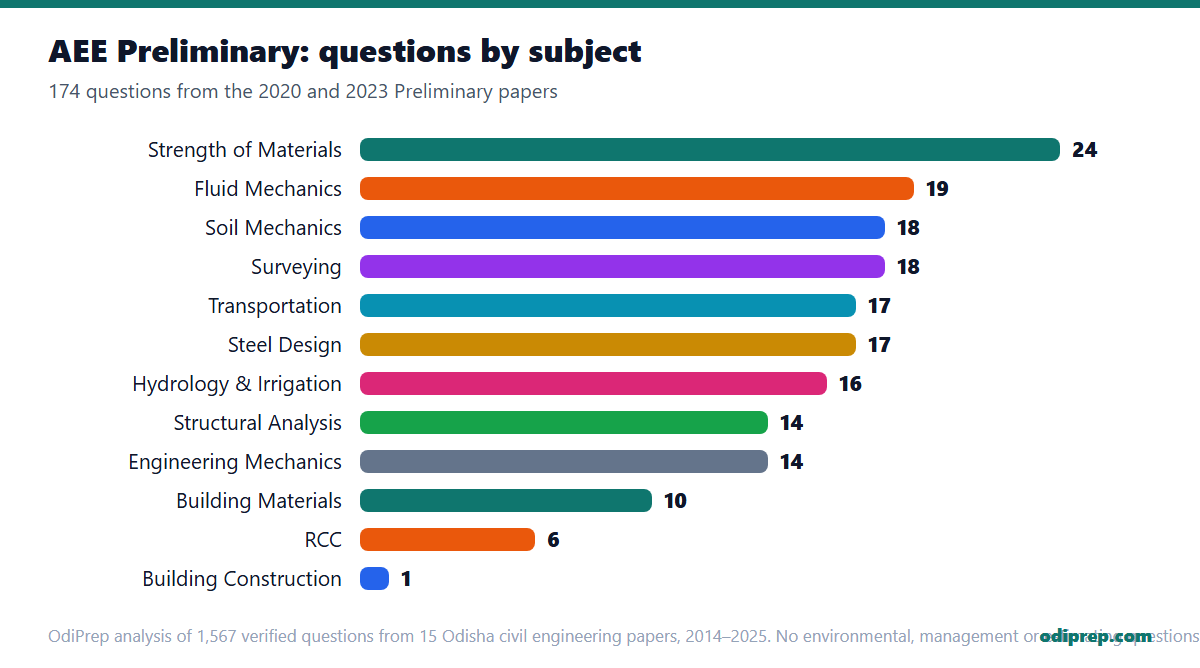
The Prelim syllabus lists ten subjects of 10 marks each: engineering mechanics, strength of materials, structural analysis, concrete, steel, solid mechanics, fluid mechanics, irrigation, transportation and surveying. The 2023 Prelim (Series A) was set in exactly these ten blocks, with one difference worth knowing: the second block (Q11–20) was soil mechanics, not a second strength-of-materials block.
Key findings
- The Prelim tests core science: mechanics, strength of materials, fluids and surveying get more weight than in the Main.
- No environmental engineering, construction management or estimating in 174 Prelim questions. Do not spend Prelim time on them.
- Engineering mechanics (Lami's theorem, friction, moment of inertia, impulse and momentum) is worth a full 10 marks here and almost nothing elsewhere.
Main Paper II Follows Its Syllabus Almost Exactly
Paper II has eleven units: nine of 30 marks (about 15 questions each), transportation with 20 marks (10 questions) and surveying with 10 marks (5 questions). We compared this with the two most recent papers.
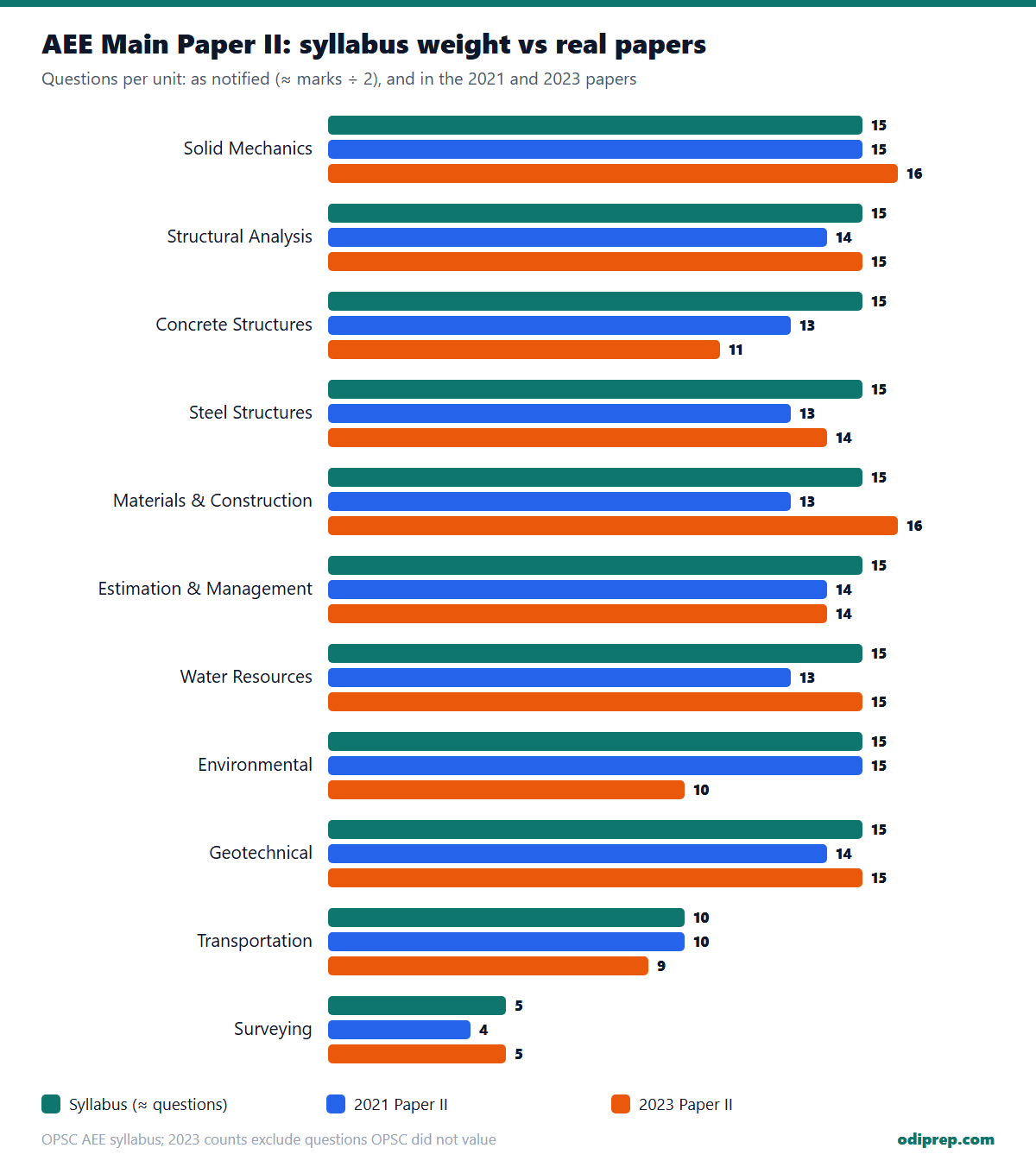
- Both the 2021 and 2023 papers match the notified weights within one or two questions per unit. You can plan your revision directly from the syllabus table.
- The 2021 computer-based paper asked the units in syllabus order (Q1–15 solid mechanics, Q16–30 structural analysis and so on). The 2023 OMR paper kept the same weights but shuffled the questions.
- Concrete and environmental engineering look lower in 2023 only because OPSC did not value a few of those questions.
Which Subjects Carry the Most Marks?
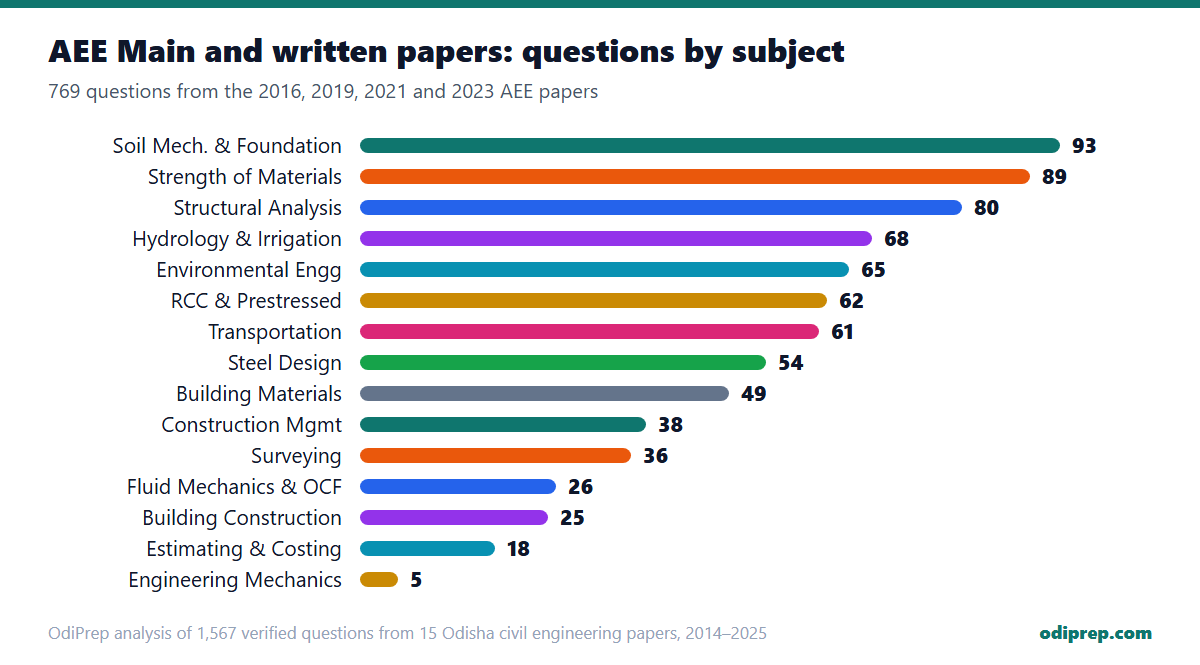
| Subject | Questions | Share |
|---|---|---|
| Soil mechanics and foundation | 93 | 12.1% |
| Strength of materials | 89 | 11.6% |
| Structural analysis | 80 | 10.4% |
| Hydrology and irrigation | 68 | 8.8% |
| Environmental engineering | 65 | 8.5% |
| RCC and prestressed concrete | 62 | 8.1% |
| Transportation | 61 | 7.9% |
| Steel design | 54 | 7.0% |
Soil mechanics, strength of materials and structural analysis together give about a third of all AEE Main questions. Make these your first block of study.
How Hard Are the Papers?
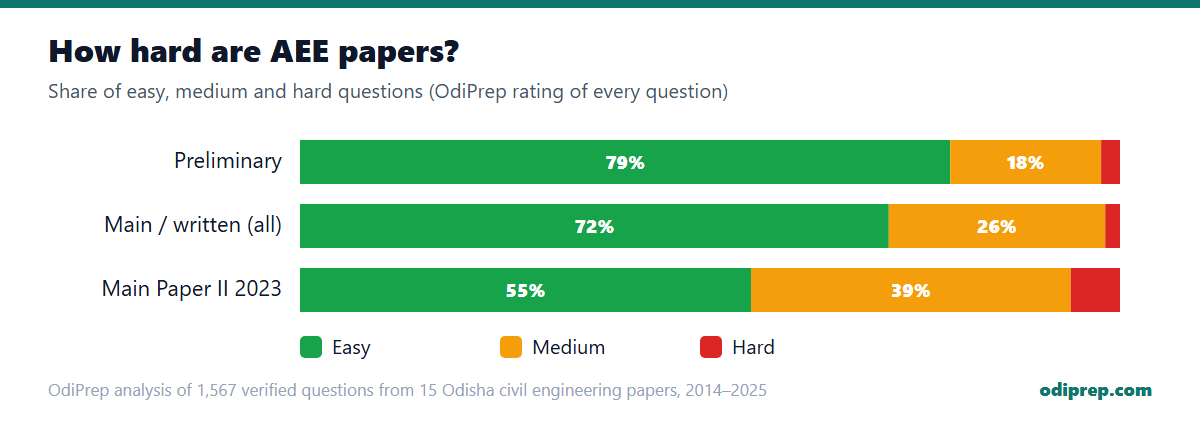
- About three in four AEE questions are direct recall or one-step: definitions, code values and standard formulas.
- The 2023 Main Paper II was clearly harder: 39% medium and 6% hard questions, against about 26% medium and 2% or fewer hard in 2019 and 2021. It also had 15 figure-based questions (earlier papers had 0–2), matrix flexibility, multi-statement items and clauses from IS 800, IS 13920 and IS 2911.
- About 11% of questions need a calculation. The common ones: σ = My/I and beam deflections, phase relations and flow nets, duty–delta and Lacey's formulas, BOD and chlorine dose, stopping sight distance and superelevation, tape corrections and reciprocal levelling.
The Most-Tested Chapters
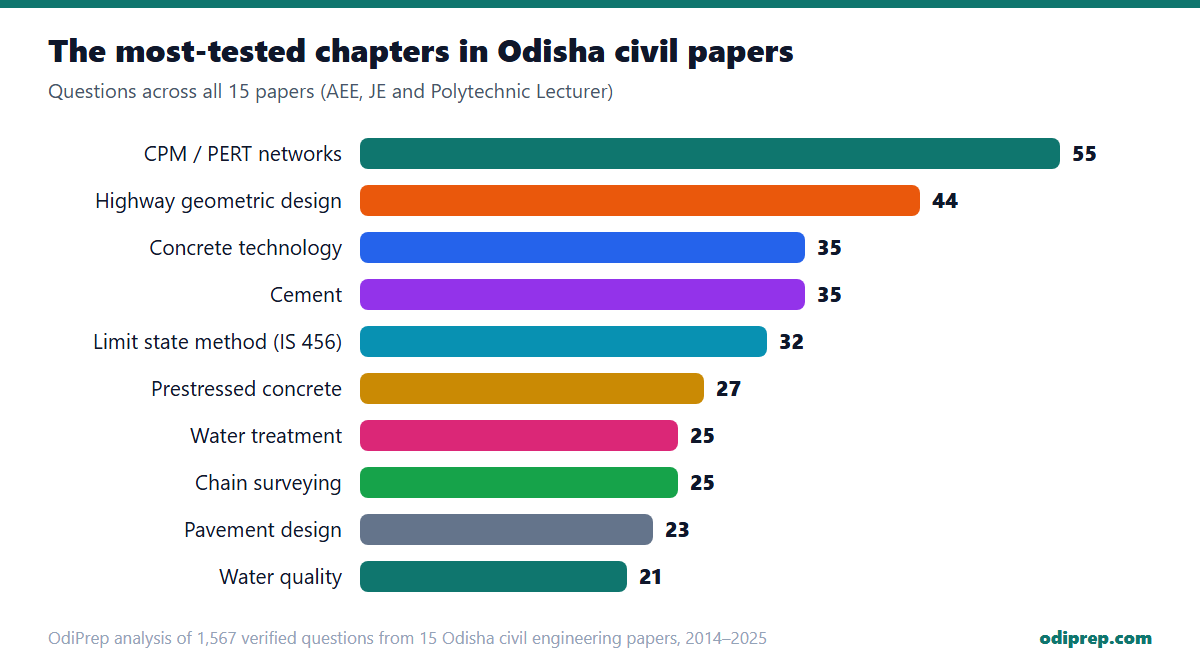
Evergreen chapters appear in ten or more of the 15 Odisha civil papers: highway geometric design, concrete technology, cement, the IS 456 limit state method, indeterminacy, sewerage, moment distribution and RCC columns.
Subtopics that keep coming back (in four or more different papers): characteristics of contours, superelevation (e = V²/127R), Poisson's ratio, special cements, bonds in brickwork, design speed, the Müller-Breslau principle, fixed-end moments, PERT expected time (tₒ + 4tₘ + tₚ)/6, crashing and cost slope, self-cleansing velocity, the hydraulic jump, IS 456 span/depth ratios, fillet welds and Bogue compounds.
Codes Decide Many Answers
- IS 456:2000 alone underpins about 80 questions: cover, span/depth ratios, lateral ties, laps and hooks, side-face steel, partial safety factors and strain limits.
- IS 800:2007 gives about 40 more: slenderness limits, lacing and battens, plate-girder stiffeners and partial safety factors.
- From 2023, IS 13920 (ductile detailing), IS 2911 (piles), IS 1904 (settlement) and IS 10262 (mix design) also appear. In transportation, IRC 73, 37, 58 and SP:23 values are asked directly.
Keep a one-page sheet of these code numbers and values and revise it every week.
Do Questions Repeat?
- 26 questions from the 2019 Paper I reappeared in the 2021 Paper II, such as the 16φ hook anchorage, lacing for 2.5% shear and 6.6 bags of cement for 1:2:4 concrete.
- The 2023 papers were about 98% new (only 5 repeats in 223 questions).
So concepts repeat, not questions. Practise past papers to learn the concepts and the style, not to memorise answers.
A 12-Week Plan for the Written Pattern
| Weeks | Focus |
|---|---|
| 1–4 | Strength of materials, structural analysis, IS 456, IS 800 and soil mechanics, with a code-values sheet |
| 5–8 | Water resources, environmental, transportation and surveying, with formula sheets (Lacey, Khosla, BOD, SSD, superelevation, tape corrections) |
| 9–10 | Estimating and construction management (quick marks), materials and construction |
| 11–12 | Full timed papers: the Prelim in ten blocks, the Main shuffled. Review every wrong answer |
Negative marking: a wrong answer costs a quarter of the question's marks in both the Prelim and the Main. A blind guess among four options gains very little on average, but once you can rule out even one option, attempting is worth it.
On the GATE route (2026-27): the same subjects apply, but GATE asks more numerical and multi-concept questions. Add practice on the topics OPSC papers rarely ask, such as total station and GPS, matrix methods, gravity dams, flood routing and signal design.
Practise the Real Papers
Practise on a timed exam screen with the OPSC AEE (Civil) packs: full mock tests in the Preliminary and Main Paper II pattern, and real OPSC papers, including the official 2023 Preliminary and Main Paper II with OPSC's final keys, the 2021 Paper II and the 2019 and 2016 Papers I and II. Every question has a step-by-step explanation, and new tests are added to the same pack at no extra cost.
Preparing for the diploma-level post as well? Read our OSSC JE Civil exam analysis or see the OPSC AEE Civil exam page.
Frequently Asked Questions
How many questions are there in the OPSC AEE Civil Prelim? 100 MCQs of 1 mark each, in 1½ hours, with 0.25 marks deducted for each wrong answer.
What is the AEE Main pattern? Paper I General Studies (150 questions, 300 marks) and Paper II Civil Engineering (150 questions, 300 marks), each with 0.5 marks deducted per wrong answer, followed by document verification and viva.
What was the qualifying mark in 2023? 30% in the Prelim and 30% in the Main, for all categories.
Is there a written exam for AEE in 2026-27? Not under Advt. 13 of 2026-27. Selection is by GATE CE score (90%) and interview (10%).
Which subjects should I study first? Soil mechanics, strength of materials and structural analysis: together about a third of the Main paper.
Method note: OdiPrep classified every question of 15 Odisha civil engineering papers (2014–2025) by subject, chapter, format and difficulty. Questions that OPSC did not value, or that had a defect in the source, are not counted. Difficulty is OdiPrep's own rating. Exam details are from the OPSC syllabus, OPSC Advertisement No. 13 of 2026-27 and the OPSC result sheet for Advt. 33 of 2023-24; always check the latest notice on the OPSC website.