
The OSSC Junior Engineer (JE), Civil is the main diploma-level civil engineering post in Odisha, recruited by the Odisha Staff Selection Commission. This analysis explains how candidates are selected, what the syllabus covers and what the real papers have asked, so you can spend your preparation time where the marks are.
We classified 436 OSSC JE (Civil) questions from the 2014 and 2019 papers by subject, format and difficulty, as part of a wider study of 1,567 verified questions from 15 Odisha civil engineering papers.
How Selection Works: Half Written, Half Career
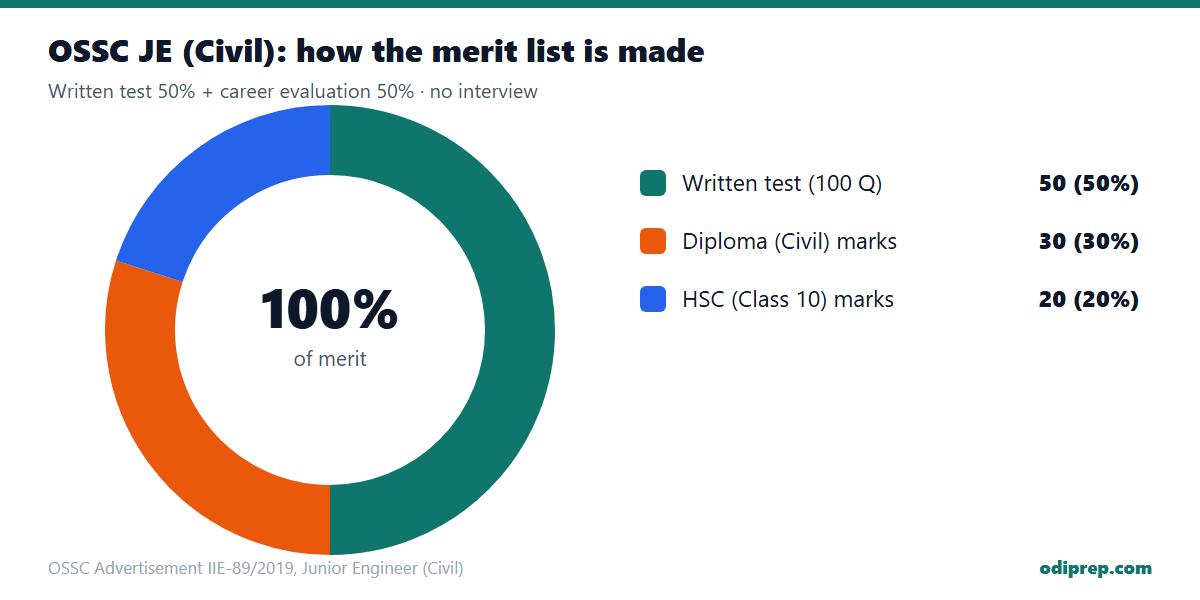
Under OSSC Advertisement IIE-89/2019 (Junior Engineer (Civil) under the Engineer-in-Chief, Water Resources):
| Stage | Weight | What it is |
|---|---|---|
| I. Written test | 50% | 100 objective questions, 100 marks, 1½ hours, 0.25 marks deducted per wrong answer (OMR or computer-based) |
| II. Career evaluation | 50% | HSC (Class 10) marks 20% + Diploma in Civil Engineering marks 30% |
| III. Certificate verification | About two candidates per vacancy in each category, by combined merit |
There is no interview. Your diploma and HSC marks are already fixed, so the written test is the only part you can still improve, and every mark in it counts.
The 2019 recruitment at a glance: 257 posts (91 for women); a Diploma in Civil Engineering recognised by SCTE&VT Odisha (distance-mode diplomas not eligible); age 21–32 years with the usual relaxations; Odia at ME (Class VII) standard; contractual appointment at ₹16,880 a month at that time.
Later OSSC recruitments for JE (Civil), including combined technical services exams, may use a different pattern. Always check the current advertisement on ossc.gov.in before you apply.
The Syllabus: 12 Heads from the Civil Diploma
The written test covers the 2nd and 3rd year Diploma (Civil) subjects of SCTE&VT Odisha:
| Head | What it covers |
|---|---|
| Hydraulics | Hydrostatics, fluid flow, pumps |
| Survey | Chain, compass, plane table, levelling, contouring, theodolite, traversing, tacheometry, curves, modern surveying |
| Civil engineering materials | Stone, bricks, cement, sand, mortar, concrete, timber, paints, steel, bitumen |
| Construction technology | Foundations, walls, damp proofing, arches and lintels, doors and windows, floors, roofs, stairs, finishes |
| Structural analysis | Trusses, frames, slope and deflection, fixed and continuous beams, moment distribution, three-hinged arches |
| Transportation engineering | Roads, railways, bridges, docks and harbours, airports, tunnels |
| Irrigation engineering | Hydrology, crop water requirement, canals, headworks, cross-drainage works, dams, waterlogging |
| Estimating | Building estimates (PWD), rate analysis, roads, culverts, irrigation structures, PWD accounts |
| Structural design | RCC (WSM and LSM), slabs, columns, stairs, footings; steel and timber members |
| Public health engineering | Water supply, treatment, plumbing, sewers, sewage treatment, rural sanitation |
| Construction management | Planning, site organisation, labour, equipment, quality control, safety |
| Advanced construction technology | Concrete mix design, earthquake-resistant construction, building services, earth-moving equipment |
What the Papers Actually Ask
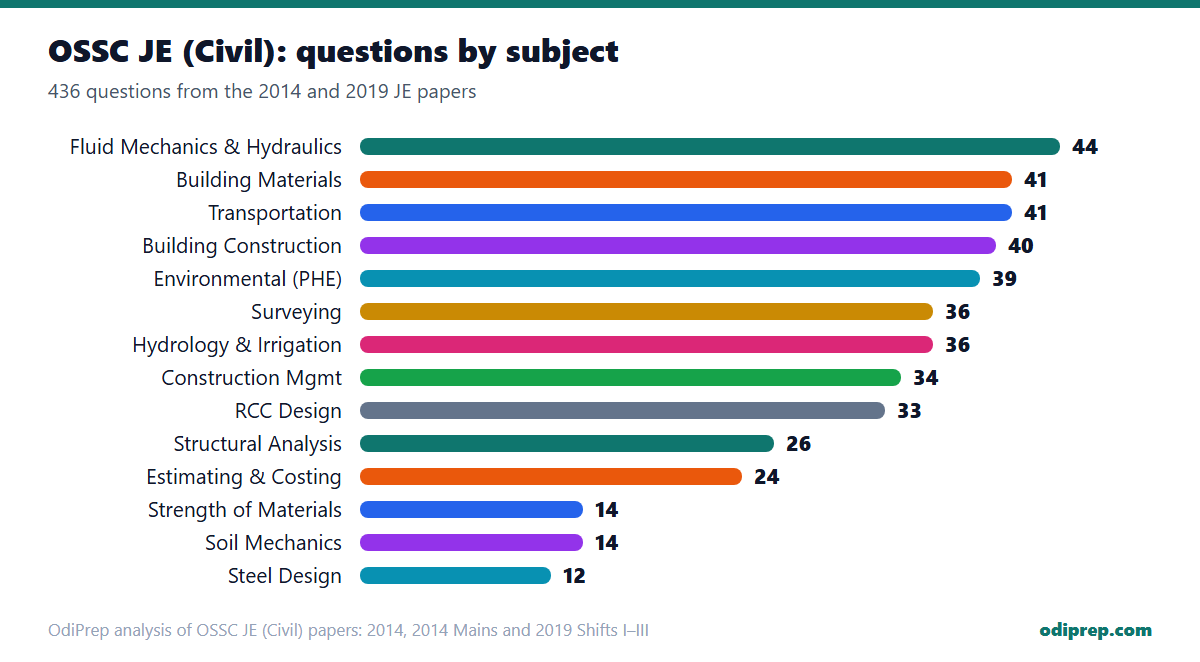
| Subject | Share | What comes up most |
|---|---|---|
| Fluid mechanics and hydraulics | 10.1% | Hydrostatics, manometers, flow measurement, pipe flow |
| Building materials | 9.4% | Cement, bricks, stones, timber, concrete |
| Transportation | 9.4% | Highways, railways, bridges, airports, tunnels |
| Building construction | 9.2% | Brick bonds, stairs, damp-proof course, scaffolding, doors |
| Environmental (public health) | 8.9% | Water quality and treatment, sewers |
| Surveying | 8.3% | Chain, compass, levelling, contours |
| Irrigation | 8.3% | Duty and delta, canals, headworks |
| Construction management | 7.8% | CPM and PERT, equipment |
| RCC design | 7.6% | IS 456 detailing rules |
Key findings
- The paper is broad and even. No single subject is more than about 10%, so skipping any head costs marks.
- Practice-based subjects dominate: materials, construction, management and estimating together give about 32% of the questions.
- Strength of materials, soil mechanics and steel are light (about 3% each). Cover the basics and move on.
JE Is Not a Smaller AEE
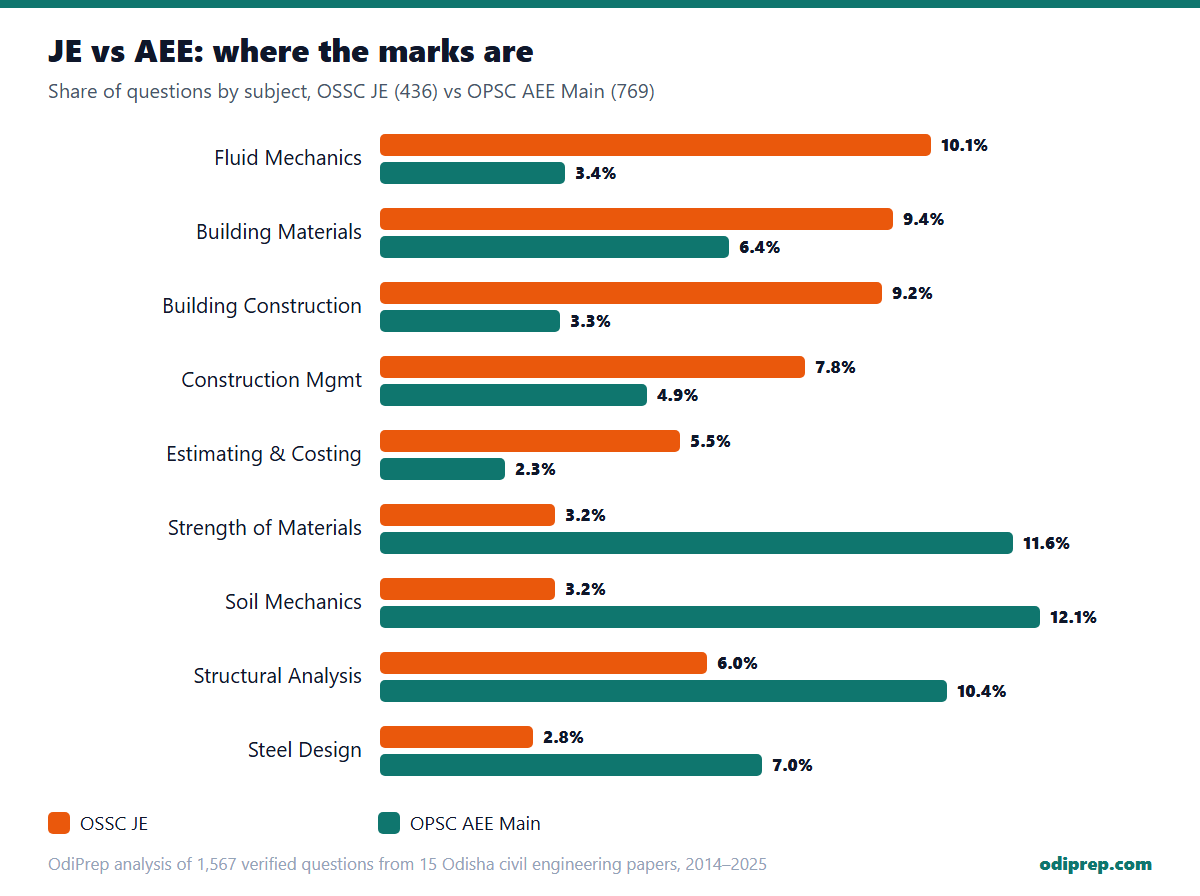
Many candidates prepare for JE with AEE books. The data shows why that is a mistake: the AEE Main leans on theory (soil mechanics, strength of materials, structural analysis), while JE leans on site practice (materials, construction, management, estimating and hydraulics). Materials, construction, management and estimating are about 32% of JE but only about 17% of the AEE Main. Use diploma-level books and practise JE-style questions.
How the Questions Are Asked
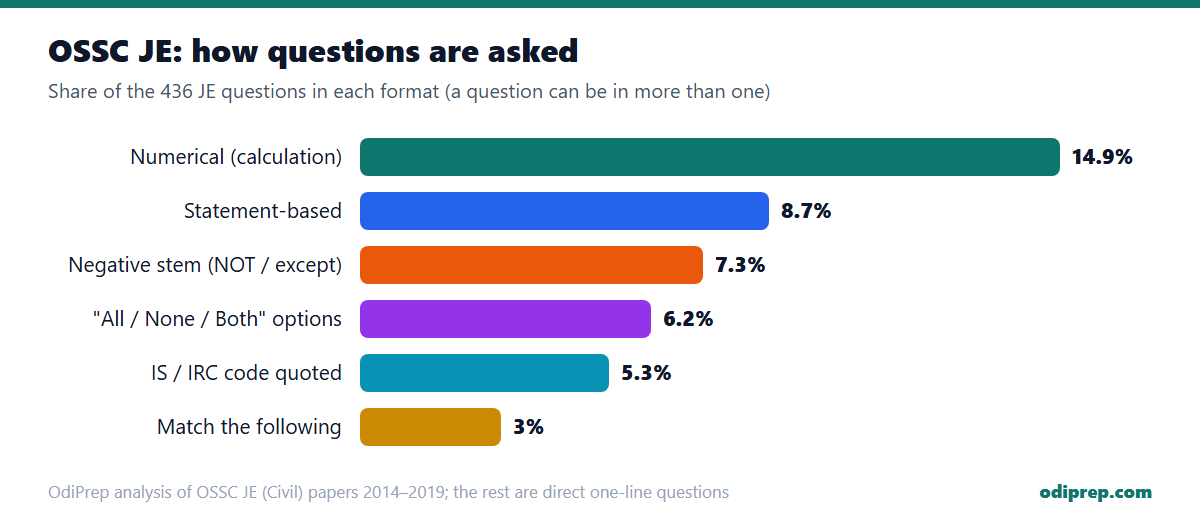
- About two in three questions are direct one-liners: "is called", "is used for", "the value of".
- 15% need a short calculation, more than in the OPSC papers. Typical ones: duty–delta, cement bags for a concrete mix, tape corrections, stopping sight distance, simple stress and deflection.
- Statement-based questions (8.7%) and match-the-following (3%) are more common in JE than in AEE. Read every statement carefully before you mark.
- IS and IRC codes are quoted in about 5% of questions (IS 456, IS 1200, IS 10500, IRC values).
- In the JE papers, answer C came up somewhat more often than the others, but no option is safe to guess blindly.
Difficulty
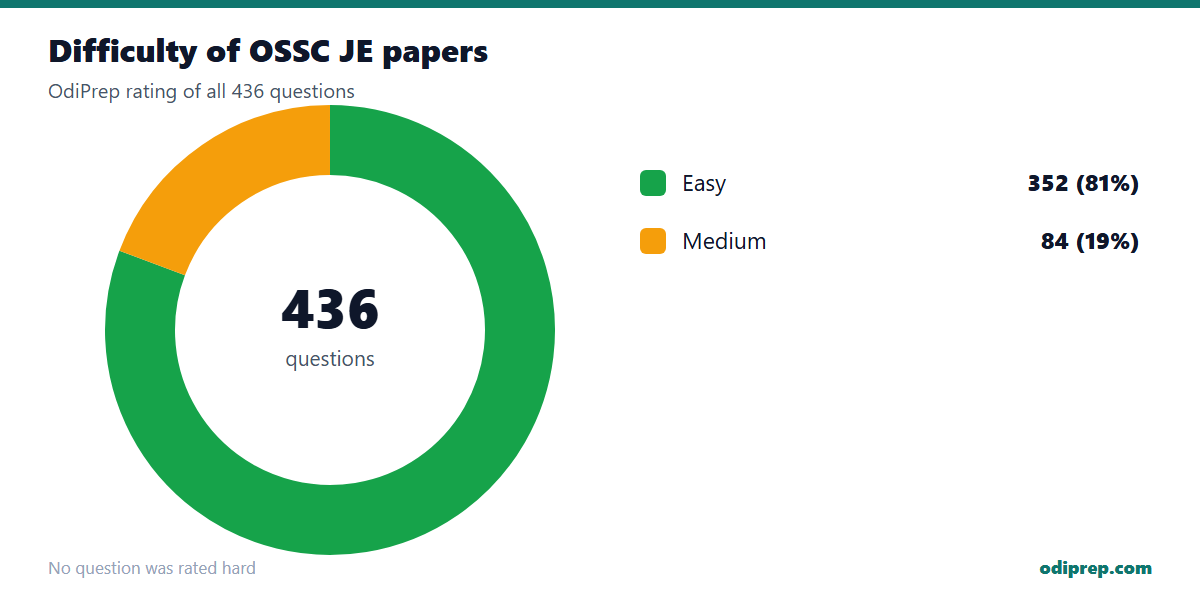
About 81% of JE questions are easy and the rest medium; none was rated hard. Qualifying is not the challenge; the merit list is decided by accuracy. A wrong answer costs 1.25 marks compared with a right one (the mark you miss plus the 0.25 penalty), so avoid careless mistakes on easy questions.
Do Questions Repeat?
Exact repeats are rare across years, but the same concepts keep returning: brick bonds, contours, superelevation, special cements, Bogue compounds, PERT time estimates, self-cleansing velocity and the hydraulic jump. In the 2019 recruitment the shifts were very similar to each other, so a paper from one shift is excellent practice for the next.
How to Prepare for the Written Test
- Take one full paper under exam conditions (100 questions, 90 minutes, negative marking) to find your starting point.
- Cover all 12 heads. Start with the high-share practical subjects: materials, construction, hydraulics, transportation and public health.
- Make formula and code sheets: duty–delta, Lacey, PERT, SSD and superelevation, tape corrections, IS 456 cover and spacing rules, IS 10500 drinking-water limits, IS 1200 units.
- Practise calculations daily: 10 short numericals a day build the speed you need for 90 minutes.
- In the last month, take a full paper every two or three days and review every wrong answer and every guess.
Practise the Real Papers
Practise on a timed exam screen with the OSSC JE (Civil) packs: full mock tests in the JE pattern and the real 2019 and 2014 JE papers, with the official +1 / −0.25 marking and a step-by-step explanation for every question. New tests are added to the same pack at no extra cost.
Aiming for the degree-level post too? Read our OPSC AEE Civil exam analysis or see the OSSC JE Civil exam page.
Frequently Asked Questions
What is the OSSC JE (Civil) exam pattern? One objective paper of 100 questions and 100 marks in 1½ hours, with 0.25 marks deducted for each wrong answer (2019 advertisement).
How is the final merit list made? Written test 50% plus career evaluation 50% (HSC 20% and Diploma 30%), followed by certificate verification.
Is there an interview for OSSC JE Civil? No.
Is the syllabus diploma-level? Yes: the 2nd and 3rd year Diploma (Civil) subjects of SCTE&VT Odisha, under 12 heads.
Which subjects carry the most questions? Fluid mechanics and hydraulics, building materials, transportation, building construction and public health engineering, each about 9–10%.
Method note: OdiPrep classified all 436 retained questions of the OSSC JE (Civil) 2014, 2014 Mains and 2019 Shift I–III papers by subject, format and difficulty. Questions with a defect in the source are not counted. Difficulty is OdiPrep's own rating. Exam details are from OSSC Advertisement IIE-89/2019; always check the latest notice on the OSSC website.